
Data Augmentation Vs. Data Enrichment: What’s The Difference?
When working with data management and analysis, you’ll undoubtedly see a lot of buzzwords thrown around. At some point, you may find yourself asking about these impractically-specific niche terms, questions like “What’s data augmentation?” or “What’s data enrichment?” and “why are these different?” are all pretty valid, after all. While these terms might seem similar, they have different implications and applications in the context of improving and enhancing your company’s data. Let’s attempt to make the word soup a little less foggy and differentiate these terms.
Data augmentation refers to the process of expanding and diversifying an existing dataset by introducing synthetic or manipulated data points. It aims to increase the size, quality, and diversity of the available data to enhance machine learning models’ performance and generalizability. This means that data augmentation techniques involve applying various transformations to existing data to expand on more generalized information.
The primary purpose of data augmentation is to overcome limitations caused by restricted data availability. By creating additional variations of the original dataset, data augmentation helps prevent overfitting and improves the model’s ability to recognize patterns and make accurate predictions when exposed to new and unseen data.

Data enrichment, on the other hand, involves enhancing existing data by appending or supplementing it with additional information from external sources. This process enriches the dataset with valuable insights, context, and attributes that were not previously available. Data enrichment techniques aim to fill gaps, improve accuracy, and enhance the completeness of the data.
Data enrichment involves integrating diverse data sources, such as public databases, social media, or third-party providers, to extract relevant information. This additional data can include demographic details, contact information, asset data, historical records, or identity analysis. By incorporating this enriched data into existing datasets, businesses gain a more comprehensive understanding of their customers, markets, and operations.

Although both data augmentation and data enrichment contribute to improving the quality and usefulness of datasets, there are distinct differences between the two. Data augmentation and data enrichment do not share the same purpose. Augmentation focuses on expanding the dataset’s size and diversity, mainly for machine learning purposes, to improve model performance. Enrichment, however, aims to enhance the existing data by adding supplementary information from external sources to gain deeper insights.
There are also different techniques for pursuing both. Data augmentation involves applying various transformations or manipulations to the existing data, such as scaling, flipping, or noise addition. In contrast, data enrichment requires integrating external data sources, cleaning and validating the data, and appending the relevant information to the existing dataset. We also have to consider th input and output of data with each strategy. Data augmentation takes an existing dataset as input and generates an augmented dataset with expanded variations as output. Data enrichment takes an existing dataset as input and supplements it with additional information, generating an enriched dataset as output.
In general, data augmentation techniques are commonly used in machine learning and computer vision tasks, where the quantity and diversity of data significantly impact the model’s performance. This isn’t exactly the case for data enrichment, as it finds applications in various domains, including marketing, customer relationship management, and data analysis, where additional context and insights are valuable.
We understand the importance of data enrichment in empowering businesses with comprehensive and accurate information. We offer a range of data enrichment tools and services tailored towards improving the quality of your data. Our data enrichment tools employ advanced algorithms and techniques to clean and validate information, identifying and correcting inconsistencies to ensure accuracy and reliability for your datasets.
Contact Enrichment API can be used to add additional information to contact records, such as social media profiles, employment information, and more. This can help businesses better understand their customers and target their marketing and communication efforts more effectively. By integrating with the Contact Enrichment API, businesses can ensure that their contact data is always up-to-date and accurate.
CallerID can be used to identify the owner of a phone number and provide additional information about them, such as their name, address, and social media profiles. This can be useful for businesses that rely on phone communication to reach their customers, as it can help them better understand who they are talking to and tailor their communication accordingly.
AddressID can be used to verify and enrich address data by adding missing information, such as geolocation data or building information. This can help ensure that address data is accurate and up-to-date, which is important for businesses that rely on accurate address data for shipping, logistics, and customer communication.
EmailID can be used to identify the owner of an email address and provide additional information about them, such as their social media profiles and job title. This can be useful for businesses that use email communication to reach their customers, as it can help them tailor their communication to the recipient’s interests and needs.




Depending on your companies needs, you can find the right tools for your data enrichment solutions on our Developer API page, where you can browse a full list of EnformionGO API products.
Data enrichment and augmentation play pivotal roles in empowering businesses with valuable insights, improved decision-making capabilities, and enhanced operational efficiency. Here are some key benefits:
Improved Decision Making: Enriched and augmented data provides a more comprehensive view of your customers, markets, and operations. This enhanced understanding enables you to make data-driven decisions, identify opportunities, and mitigate risks effectively.
Enhanced Customer Insights: By enriching customer data with demographic, firmographic, and social media information, you gain a deeper understanding of your customers’ preferences, behaviors, and needs. This knowledge allows you to personalize marketing efforts, improve customer experiences, and build stronger relationships.
Optimized Marketing Strategies: Enriched data helps you segment your target audience more effectively, enabling you to create tailored marketing campaigns that resonate with specific customer groups. By delivering personalized messages and offers, you can increase engagement, conversion rates, and customer loyalty.
Improved Operational Efficiency: Augmented data improves the performance of machine learning models and algorithms. With more diverse and high-quality data, you can develop more accurate predictive models, optimize processes, automate tasks, and streamline operations.
Better Risk Management: Enriched data enables you to assess and mitigate risks more effectively. By incorporating external data sources, such as credit scores, fraud indicators, or market trends, you can make more informed risk assessments, prevent fraud, and minimize potential losses.
Data augmentation and data enrichment are distinct approaches to improving and enhancing your company’s data. Data augmentation focuses on expanding the dataset’s size and diversity through synthetic or manipulated data, while data enrichment involves appending additional information from external sources to enhance the existing data.
Today organizations have access to vast amounts of data, and the key to staying current lies in extracting meaningful insights from that data. Data augmentation and data enrichment are two valuable strategies that help businesses unlock the full potential of their data assets.
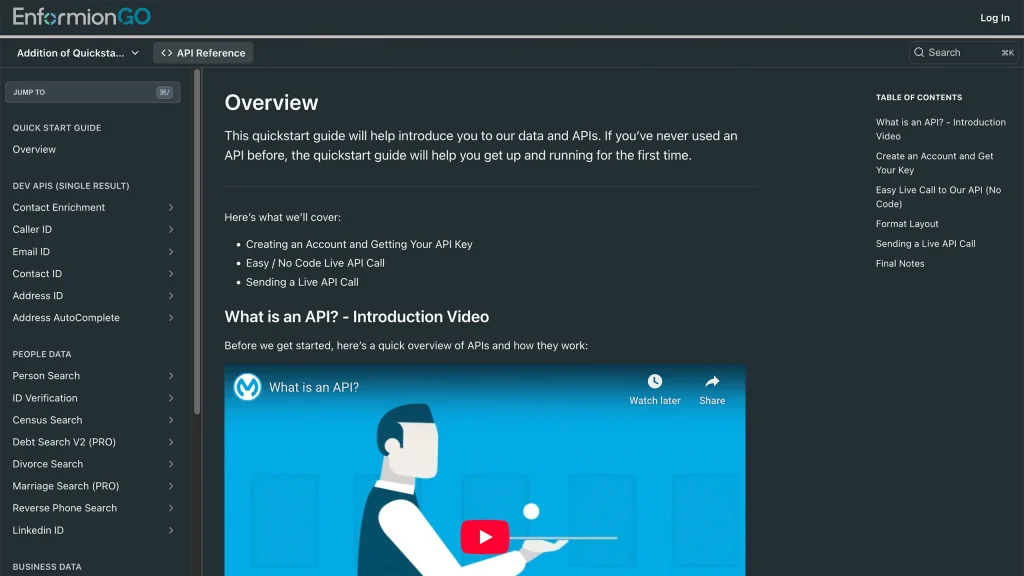
Getting familiar with how to use EnformionGO’s search and API products is very helpful in deciding what products you’ll want to use. We’ve created this quick start guide to walk new users through how to use EnformionGO. Happy searching!