
Identity Graph: Connect People and Data Points
Information about a single person is often spread across many records. A name appears in one system, an address in another, and a business affiliation somewhere else. On their own, these fragments are hard to use. An identity graph connects them, linking related data points into a single, more complete view.
This guide explains what an identity graph is, how it comes together, and how businesses use connected identity data for verification, enrichment, and research. To explore connected data yourself, you can create a free account with EnformionGO.
What Is an Identity Graph?
An identity graph is a structured map of the relationships between data points that belong to the same person or entity. Think of each piece of information as a node and each confirmed relationship as a connection between nodes.
A simple identity graph might link:
- A person’s name and known addresses
- Associated contact details
- Business affiliations
- Related asset or court record information
Instead of treating these as separate records, the graph shows how they relate, which makes the overall picture easier to understand and verify.
How an Identity Graph Comes Together
Building an identity graph starts with data from many sources and the work of matching related records. The process generally involves:
- Collecting data points from internal systems and external sources.
- Matching records that likely refer to the same person or business.
- Cross-referencing details across sources to confirm connections.
- Updating the graph as new information becomes available.
Source breadth plays a major role. EnformionGO draws on more than 6,000 unique data sources, providing identity, people, business, asset, and court record data that teams can use to cross-reference and connect the information they already have.
Why Connected Data Matters
Disconnected records create friction. Teams may contact the same person twice, overlook useful context, or rely on outdated details. Connecting data points helps address these problems.
Fewer duplicates
Linking related records reveals when several entries describe the same person, making cleanup easier.
More complete profiles
Connected data fills gaps that a single record cannot, giving teams fuller context for research.
Greater confidence
When multiple sources support the same connection, teams can rely on it with more certainty. Start Free to see connected identity data in action.
Business Uses for Identity Graphs
Identity graphs support a range of appropriate business workflows:
- Data verification: Confirming that records are accurate and consistent across systems.
- Data enrichment: Adding connected details to incomplete profiles.
- Marketing and segmentation: Building audiences from unified, deduplicated records.
- Sales research: Understanding the people and businesses behind an opportunity.
- Real estate research: Connecting people, property, and address information.
Teams can access this kind of data through self-service searches or integrate it into their own applications with an API.
Build a Clearer View of Your Data
An identity graph turns scattered fragments into connected, usable information. By linking people and data points across reliable sources, businesses can keep records cleaner, research more efficiently, and work with greater confidence.
The guidance below shows how to begin working with connected data. Get Started with EnformionGO.
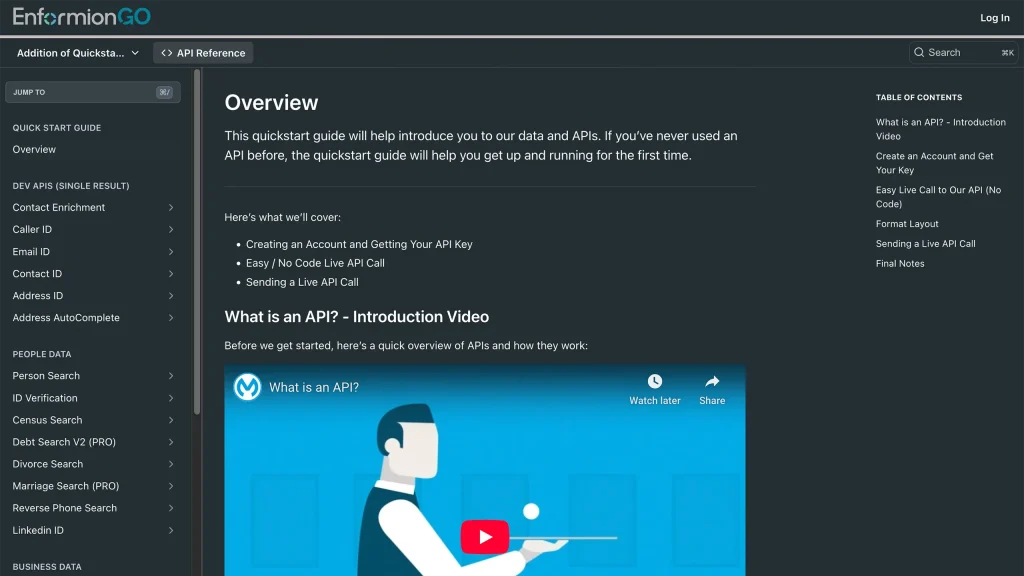
Getting familiar with how to use EnformionGO’s search and API products is very helpful in deciding what products you’ll want to use. We’ve created this quick start guide to walk new users through how to use EnformionGO. Happy searching!