
What Is A UCC Filing?

There are many business records that can help a business or individual understand more about another business. For example, you may want to view a business’s credit score, learn about the owners of a business, or search for a business’s tax filings. All of these searches can help an individual or business learn about another business, its payment history, and its creditworthiness. But how else can you learn about a business? Another way to understand a business and its credit history is with Uniform Commercial Code (UCC) filings. Though a UCC filing won’t directly affect a business’s credit score, it can show up on a credit report and reveal information about a business’s finances — which is why it can be important to search UCC filings in a public and private records database when trying to learn about a business.

A UCC filing is a filing that a lender places on a debtor’s assets, usually business assets, stating that the lender has a right to repossession of those assets until the loan is completely paid off. For example, when a business doesn’t have funding for capital on its own, it may take out a loan to fund the capital from another business. To ensure the loan is paid back and protect the lender’s finances if it isn’t, the lender will file a UCC filing, stating that the lender has the right to repossess whatever capital they financed if the debtor defaults on their debt. If the debtor doesn’t pay back a debt, the debtor may take possession of those assets again.

marketing investigation skip tracing api

Though a UCC filing does not directly affect the credit score of a business, it does reveal information about that business’s finances and payment history that may be useful to another business, a financial private investigator, or a legal professional. For example, if you’re in a financial services business and you’re considering giving a loan to a business, searching UCC filings can be an important piece of performing due diligence. If a business has prior UCC filings, you may be less likely to provide credit or loan to that business because if the business does not pay your loan back, other businesses that filed a UCC filing before having the right to repossess assets before you do. UCC filing searches can also be an important part of vendor risk assessment tools. If a business has multiple UCC filings, that may make a business more high risk because it shows they have a lot of debt. While UCC filings don’t always mean a business has risky payment behavior, it is still important to access them because they reveal business relationships, like creditor-debtor relationships, which are important in building a profile on and investigating the history of another business.
marketing data financial search

A UCC filing is a public record, meaning a business’s UCC filings can be accessed in a public records database. Usually, businesses, like corporations or financial services, will want to access other businesses’ UCC filings using corporate software services to do management due diligence before purchasing, investing in, or lending to that business. Legal professionals may also access UCC filings to perform due diligence or authenticate a business. Collections agencies or repo services can also search UCC filings using collections software solutions to assess if they have a right to personal asset recovery on that business.

There are many reasons for a company would use UCC filings, primarily to secure loans. When a company loans money to another business or individual, it wants to ensure that it has a legal claim on some of that debtor’s property in case the loan is not repaid. By filing a UCC financing statement with the appropriate state agency, the lender can establish a security interest in the debtor’s personal property, such as inventory, equipment, or accounts receivable. This provides the lender with a legal claim on the property in case the debtor defaults on the loan.

UCC filings can also be used by companies that sell goods on credit. When a seller extends credit to a buyer, they are taking on the risk that the buyer may not pay for the goods. By filing a UCC financing statement, the seller can establish a security interest in the goods sold, which means that if the buyer does not pay, the seller can repossess the goods and resell them to recoup some of its losses.

Another use of UCC filings is in mergers and acquisitions. When one company acquires another, it may assume some of the acquired company’s liabilities. By conducting a UCC search, the acquiring company can determine if there are any outstanding UCC filings against the acquired company’s assets. This information can be used to negotiate the terms of the acquisition and to protect the acquiring company’s interests.

To get started accessing UCC filings, use a public and private database like EnformionGO. EnformionGO allows you to easily search UCC filings by SSN, EIN, business name, creditor name, address and more. With a UCC filing search in EnformionGO, you can gather UCC filing date and history plus business details, SIC classification, risk scores, creditor and debtor information and more — all of which can help you understand more about a business and perform due diligence.


If you’d like to learn even more about a business using EnformionGO’s public and private records database, you can search other business records and view business credit reports, perform a combined business search, or search DBA/FBN records, FEIN-Tax ID records, corporate records, and workplace records. And with fast people find through API and batch processing solutions, you can customize your data collection methods to fit your unique needs.

UCC filings are a valuable tool for companies in a variety of situations, including when offering financing, selling goods on credit, and engaging in mergers and acquisitions. By establishing a security interest in a debtor’s personal property, companies can protect themselves against financial losses and ensure that they have legal recourse in case of default.
Graphic depicting data marketers working on an enhanced contact list
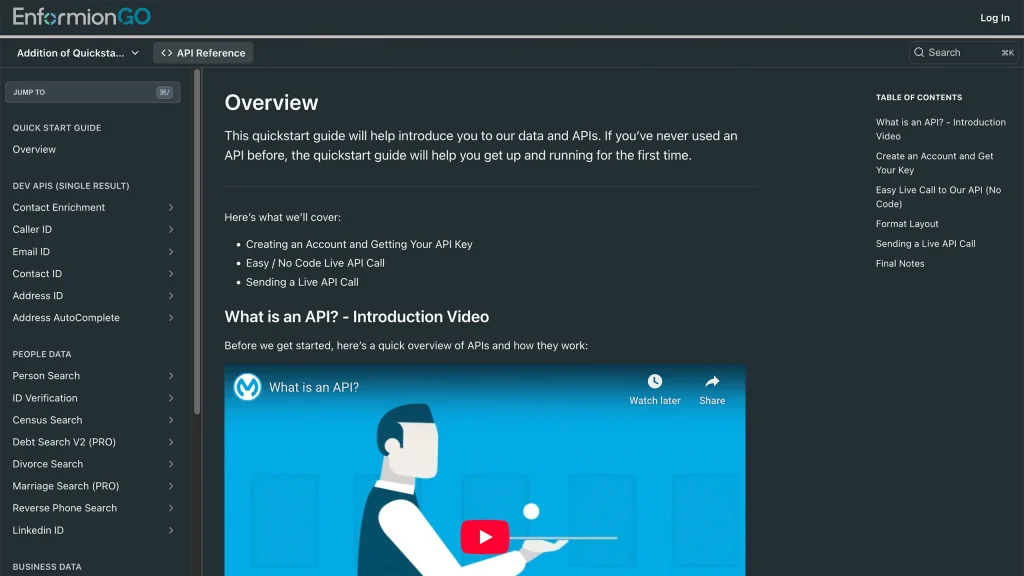
Enformiongo api documentation readme

Getting familiar with how to use EnformionGO’s search and API products is very helpful in deciding what products you’ll want to use. We’ve created this quick start guide to walk new users through how to use EnformionGO. Happy searching!

Pro License Data

Filter Pro License Data using the fields below.

  • License Status
    • Multi select
      Description: Select the license status(es) you want to target. You can select more than one


  • License Issuing State
    • Multi select
      Description: Select the license issuing state(s) you want to target. You can select more than one.


  • License Issuing Date Range
    • Select the date range for when the target matches had their license issued.
  • License Expiration Date Range
    • Select the date range for when the target matches had their license expire.

Workplace & Corporation Data

Filter Workplace Data using the fields below.

  • Years at Company
    • Field type: input
    • Description: Enter the number of years at a company for your target matches.
  • Job Title Level
    • Multi select
      Description: Select the job title level(s) you want to target. You can select more than one.
  • Department
    • Multi select
      Description: Select the department(s) you want to target. You can select more than one.
  • Company Revenue Range
    • Field type: range – min/max ($0 – $100,000,000)
    • Description: Set the company revenue range for your matches
  • Company Size
    • Field type: range – min/max (0 – 10,000)
    • Description: Set the company size range for your matches
  • Office Location City
    • Field type: input
    • Description: Enter the office location city name you want to target
 
  • Office Location County
    • Field type: input
    • Description: Enter the office location county name you want to target
  • Office Location State
    • Field type: Multi-select
    • Description: Select the office location state(s) you want to target. You can select more than one.
  • Office Location Zip
    • Field type: input
    • Description: Enter the office location zip code you want to target

Property Data

Filter Property Data using the fields below.

  • Number of Property Owners
    • Field type: range – min/max (0 – 50)
    • Description: Set the range of the number of owners for one of the properties linked to each match you want to target
  • Land Use Code
    • Field type: input
    • Description: Enter the land use code (number only) for one of the properties linked to each match you want to target. For example, for “1100: Single-Family Home” you would enter “1100”
  • Total Square Footage
    • Field type: input
    • Description: Enter the total square footage (number only) for one of the properties linked to each match you want to target

  • Property Value
    • Field type: range – min/max (0 – 10 million)
    • Description: Set the range of the property value for one of the properties linked to each match you want to target
  • Mortgage Amount
    • Field type: input
    • Description: Enter the mortgage amount (number only) for one of the properties linked to each match you want to target
  • Purchase Date
    • Field type: input
    • Description: Enter the purchase date (number only) for one of the properties linked to each match you want to target
  • Property Type
    • Multi select
      Description: Select the property type(s) you want to target. You can select more than one.
  • Owner Type
    • Multi select
      Description: Select the owner type(s) you want to target. You can select more than one.
  • Owner Status
    • Multi select
      Description: Select the owner status(es) you want to target. You can select more than one.
  • Owner Occupied
    • Field type: Boolean
    • Description: Select if you require for one of the properties to be owner-occupied

Consumer Insights Data

Filter Consumer Insights Data using the fields below.

  • Presence of Children
    • Field type: Boolean
    • Description: Select if you require matches with children present in the household
    •  
  • Credit Card Holder
    • Field type: Boolean
    • Description: Select if you require matches to be a credit card holder
  • Interest in Travel
    • Field type: Boolean
    • Description: Select if you require matches to be interested in travel
  • Interest in Cooking
    • Field type: Boolean
    • Description: Select if you require matches to be interested in cooking
  • Interest in Reading
    • Field type: Boolean
    • Description: Select if you require matches to be interested in reading


  • Smoker
    • Field type: Boolean
    • Description: Select if you require matches to be a smoker
  • Exercise Enthusiast
    • Field type: Boolean
    • Description: Select if you require matches to be an exercise enthusiast
  • Exercise with Running
    • Field type: Boolean
    • Description: Select if you require matches who run for exercise
  • Exercise with Walking
    • Field type: Boolean
    • Description: Select if you require matches who walk for exercise
  • Does Aerobic Exercise
    • Field type: Boolean
    • Description: Select if you require matches who do aerobic exercise
  • Into Camping / Hiking
    • Field type: Boolean
    • Description: Select if you require matches who are interested in camping / hiking 
  • Into Natural Foods
    • Field type: Boolean
    • Description: Select if you require matches who are interested in natural foods
  • Into Beauty Health
    • Field type: Boolean
    • Description: Select if you require matches who are interested in health / beauty
  • Into Medical Health
    • Field type: Boolean
    • Description: Select if you require matches who are interested in health / medicine
  • Into the Outdoors
    • Field type: Boolean
    • Description: Select if you require matches who are interested in the outdoors
  • Into Sporty Living
    • Field type: Boolean
    • Description: Select if you require matches who are interested in the outdoors

Location Data

Filter Location Data using the fields below.

  • City
    • Field type: input
    • Description: Enter the city name you want to target
  • County
    • Field type: input
    • Description: Enter the county name you want to target
  • State
    • Field type: Multi-select
    • Description: Select the state(s) you want to target. You can select more than one.
  • Zip
    • Field type: input
    • Description: Enter the zip code you want to target
  • Population Designation
    • Field type: Multi-select
    • Description: Select the population type(s) you want to target. You can select more than one.

Person Data

Filter Person Data using the fields below.

  • Age
    • Field type: range – min/max (18 – 120)
    • Description: Set the age range for your matches
  • Education Level
    • Multi select
      Description: Select the education level(s) you want to target. You can select more than one.
  • Credit Score
    • Field type: range – min/max (0 – 850)
    • Description: Set the credit score range for your matches
  • Estimated Income
    • Field type: range – min/max ($0 – $250,000)
    • Description: Set the income range for your matches. Max setting is $250,000+.
  • Number of Properties Owned
    • Field type: range – min/max (0 – 50)
    • Description: Set the owned properties range for your matches
  • Occupation Level
    • Multi select
      Description: Select the occupation level(s) you want to target. You can select more than one.
  • Marital Status
    • Multi select
      Description: Select the marital status(es) you want to target. You can select more than one.
  • Gender
    • Multi select
      Description: Select the gender(s) you want to target. You can select more than one. Default is all.